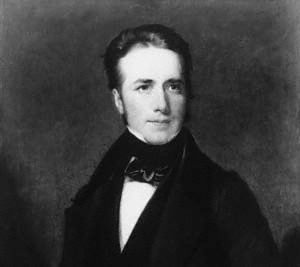
Thomas Drummond: surveyor, reforming civil servant and advocate of fair government– life after the Survey.
Thomas Drummond was essentially a man of action who threw himself, heart and soul, into whatever he did. He traced an unusual path from scientific innovation to political administration.
With the expression “Property has its duties as well as its rights,” Drummond articulated a structural imbalance in Ireland that later reform would seek to correct. At a time when authority in Ireland was too often exercised as privilege, Drummond insisted that power—especially that derived from land—carried obligations to law, order, and fairness. In office, he worked to translate that principle into practice, shaping a system of administration less dependent on influence and more anchored in rules, impartiality, and public responsibility.
Born in 1797 to a family of standing but limited means, Drummond showed early promise in mathematics. He entered the Royal Military Academy at Woolwich with the intention of becoming a military engineer, though he found the experience an unhappy one. Commissioned into the Royal Engineers in 1815, he soon wearied of routine service and considered leaving the army for the law. His direction changed after meeting Thomas Colby, later head of the Trigonometric Survey of Great Britain, who recognised in him a capacity for both invention and application. Colby provided Drummond with a field of action, where he could put his “originality of mind and energy of character” to good use.
Drummond’s development of a powerful lamp, later known as the limelight, and of reflecting mirrors known as heliotropes, enabled long-distance observations in geodetic surveying, an achievement that extended the practical range of triangulation. Its first use on Slieve Snaght was a triumph, but at a cost to his health. After a period of recovery in Edinburgh, he returned to Ireland in 1826 to continue the survey work, dividing his time between field operations and instrument improvement, contributing to the development of Colby’s compensation bars and helping to measure the Lough Foyle baseline in 1827–28. [i]
Drummond’s relationship with Colby soon began to deteriorate. Initially they were close collaborators, but tensions emerged over Colby’s rigid “blue book” survey methods, which Drummond and others saw as overly laborious and prone to inefficiency. Questions of credit, particularly around the compensation bars, added a personal edge to this disagreement.
At this time, Drummond adapted his limelight for use in lighthouses, publishing a paper On the illumination of Lighthouses in 1830. This attracted considerable attention. He was invited to present his work to King William IV, as Master of Trinity House, and later, to dine with the King and Queen. It marked his entry into wider circles of influence.
A decisive shift came in 1831 when Drummond left the Ordnance Survey, moving into government, where his influence expanded rapidly. He became friends with the Lord Chancellor, Lord Brougham, who suggested him for the chairmanship of the Boundary Commission. This arose out of the Great Reform Act of 1832, a political settlement responding to industrialisation and public pressure, which broadened the voting franchise and required parliamentary constituencies to be redrawn with greater precision.
The reforms demanded reliable geographic information . Drummond, previously embedded in the Ordnance Survey in Ireland, became part of an emerging culture of measurement-led governance in which accurate mapping and statistics formed the basis for informed state decisions. He had already helped procure the statistical information on which the Reform Bill had been founded. While not the sole actor, his work exemplified the shift in which political reform was grounded in fact, not opinion. His role was not to shape its principles but to make its consequences work on the ground, through mapping, administrative systems, and enforcement. In that sense, he represents a broader nineteenth-century transition of the state moving from patronage and approximation toward measurement, standardisation, and procedural governance.
An appointment as Private Secretary to Lord Althorp, Chancellor of the Exchequer, followed, and then in 1835 he became Under-Secretary for Ireland, based at Dublin Castle, effectively the permanent head of the British administration in Ireland. As Under-Secretary, Drummond operated at a higher level of authority in the same landscape Colby was surveying, creating an uncomfortable inversion of their earlier relationship. What began as a technical disagreement evolved into institutional separation and rivalry. [ii]
Ireland was “seething with discontent”. Catholic emancipation had altered the political balance without resolving underlying grievances, enraging vested interests without satisfying the masses. Catholics were excluded from many government jobs; tithes and rents were often collected under military protection; and the constabulary was widely distrusted. Drummond sought to impose order without coercion. He resisted the routine use of force in collecting tithes and rents, arguing that enforcement should be left to the courts. He reorganised the police and opened recruitment to Catholics. His approach combined administrative reform with a belief that legitimacy required fairness as well as authority. It earned him praise from unlikely quarters: Daniel O’Connell, champion of Catholic Emancipation and constitutional Irish nationalism, described him as “the first and only honest Lord Lieutenant I have ever seen”.
Such reforming instincts were not universally welcomed. Drummond’s support for proposals for railway development as a means of economic relief was resisted by political and commercial interests. More damaging was his intervention in local justice. In a letter to magistrates in Tipperary, he reminded them that “property has its duties as well as its rights”, a remark that provoked hostility among the Protestant landed class. The letter was suppressed, and his critics intensified their attacks.
In 1839, he was subjected to sustained parliamentary scrutiny. A Lords committee examined him over several days, and a further inquiry, chaired by Lord Roden, investigated allegations that crime had risen under his administration. Drummond responded with statistical evidence showing that crime had, in fact, declined across major categories. The episode illustrated both his reliance on evidence and the limits of its persuasive power in a charged political climate.
The work and the pressure took their toll. In 1840, he became increasingly unwell. After a long day’s work, he retired to his bed with peritonitis at his official residence in the Phoenix Park with his family around him. Within days, aged 42, he was dead. His last words were recorded as “I wish to be buried in Ireland, the country of my adoption – a country which I loved, which I have faithfully served, and for which I believe I have sacrificed my life”.
His funeral cortege had two hundred carriages and attracted a “vast concourse of people”. His friends and admirers, including O’Connell, held a meeting two days after his burial at Mount Jerome Cemetery in Dublin to decide how to commemorate his public service. The result was a statue that still stands inside the City Hall in Dublin, his military uniform draped by a Roman Cloak, a roll of papers in his hand, and a lighthouse behind his right leg.
The inscription reads, “Property has its duties as well as its rights.”
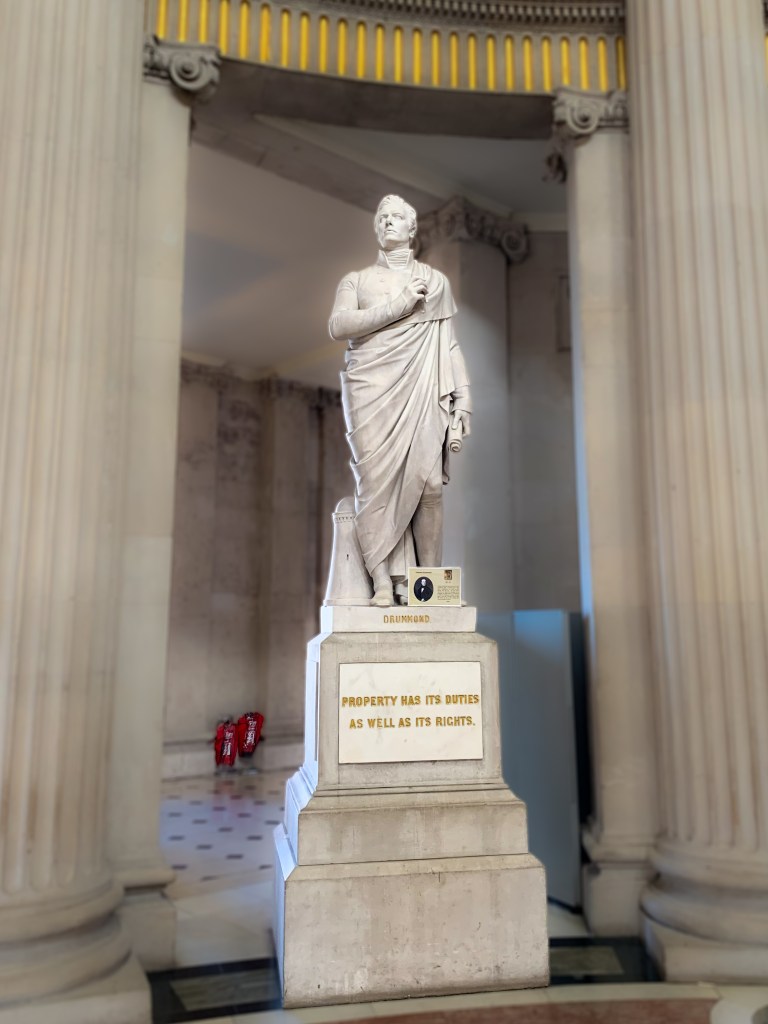
Source- Author’s photograph.
Sources:
“Thomas Drummond Life and Letters” by R. Barry O’Brien. London 1889.
“Ordnance Survey, Map Makers to Britain since 1791”, Tim Owen and Elaine Pilbeam, Ordnance Survey & HMSO, 1992.
Footnotes:
[i] See Blog Post “12. The Lough Foyle Baseline”
[ii] Colby would describe Drummond later as a “manipulator” alleging he took credit for the work on improving scientific instruments used by the Survey. Source Andrews FN 2 p89. Larcom described Drummond’s intense dislike and mistrust for Colby, and as Under-Secretary, Drummond’s attack on the Ordnance Survey Memoirs when they were under scrutiny helped deliver the fatal blow to the project. Andrews, p164.
By subscribing, you will be notified of new posts.

Responses
[…] → Read Post 21 […]
LikeLike
[…] and carried its influence far beyond the map itself. Thomas Colby provided vision and leadership; Thomas Drummond, scientific ingenuity; Thomas Aiskew Larcom, organisational discipline; John O’Donovan, […]
LikeLike