From Divis to Donegal
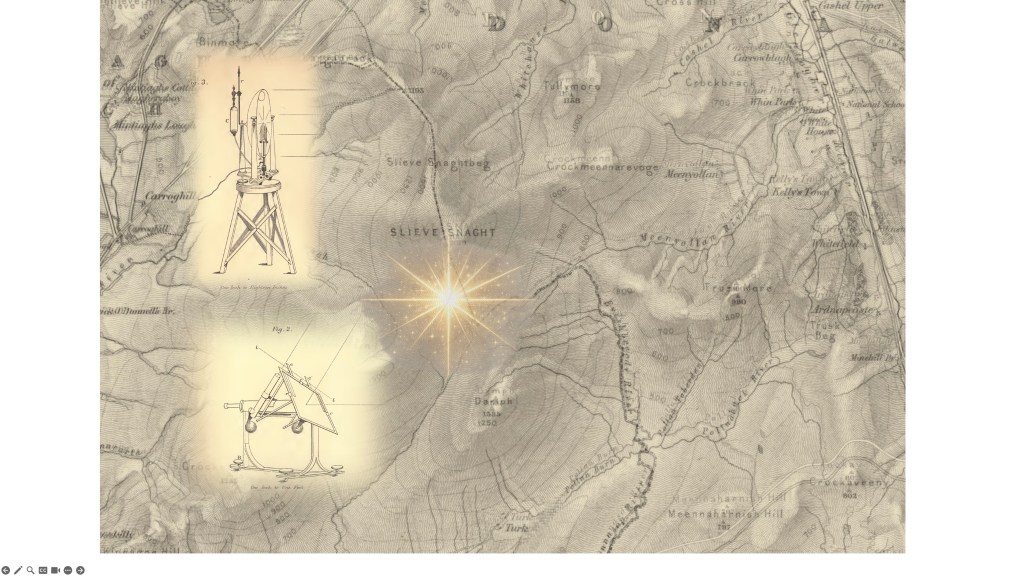
Slieve Snaght, the “Snowy Mountain”, rises modestly just over two thousand feet above sea level. Despite its unassuming height, it stands in one of the wildest and least accessible parts of Ireland, in the middle of the Inishowen peninsula, amidst bog and rocky, difficult terrain. There are no roads to its summit, no shelters, and no easy supply lines. What it did have, however, was something essential to the survey and the triangulation: from its summit, the Lough Foyle baseline could be seen, bringing distance and scale from the carefully measured line on the Magilligan plain. From it, long lines of sight could be drawn across the north of the country, linking key stations in the growing triangulation network. Also from its summit, the Scottish mountains were visible across the sea.
It was also proving nearly impossible to observe angles to Slieve Snaght. Since August 1825, a signal pole had been erected on its summit, and surveyors had tried repeatedly to sight it, day after day, week after week, from Divis Mountain, near Belfast. Each attempt failed. The distance, some sixty-seven miles, lay beyond the reach of ordinary signals. Haze obscured the view, and as the year advanced, the weather closed in. The mountain remained invisible, and by October, the effort was close to being abandoned.
The camp on Divis was preparing to withdraw for the winter when a letter arrived from another mountain station at Knocklayd, near Ballycastle. Drummond’s new heliotrope apparatus had changed the calculation. The letter described, with some excitement, a brilliant light seen clearly across a great distance, even through the haze. At times, it was visible to the naked eye, drawing an excited shout from the curious crowd the surveyors had attracted to the spot. If such a light could be established on Slieve Snaght, the line might yet be secured, but a decision was required quickly. As the weather worsened, in a landscape already known for its severity, it would be a challenge, but it was decided to attempt it. Thomas Drummond set out at once.
Leaving Belfast, he made a forced march north and west, reaching the mountain within days. By the end of October, he and a small party had established themselves on the summit. They carried everything to the summit: tents, equipment, food, water and fuel, and the apparatus for producing the target signal.
What followed was not a straightforward scientific exercise, but a struggle for survival. For the first week, the weather dominated everything as storms swept across the mountain. Tents were blown down, the cookhouse destroyed by fire, and sensitive equipment was threatened. The men themselves were pushed close to exhaustion. There was very little progress made, and the uncertainty was mentally and physically demanding.
Gradually, they imposed some order on the situation. They abandoned their tents, constructed two huts, one for the men, another for Drummond himself, built from whatever materials could be found on the summit. They sheltered as best they could against the wind, the huts offering a degree of protection. As Larcom later described:
“Here was the study and laboratory on which depended the success of the new instruments. Here were to be forfeited the delicate manipulations their adjustment required. Here was to be manufactured the oxygen destined for the portable gasometer; and, cowering over the fire, or wrapped in a pilot coat, was Drummond day and night at work.”
Snow fell and soon covered them, blending them into a bleak arctic landscape. Inside the huts, a peat fire provided heat and a measure of comfort. Drummond later wrote that his was “a lonely and humble dwelling”. But it was enough to help them persevere, and from this precarious base, the work continued.
Each day followed a pattern of waiting and watching. The men maintained a constant lookout for signals from the distant stations. The apparatus was prepared and adjusted, and the light, whenever conditions allowed, was shone. Yet success remained uncertain as the atmosphere could not be controlled over such an unforgiving distance.
Then, on the 9th of November, the weather cleared, the air steadied, and they shone their lights across the sixty-seven miles between Slieve Snaght and Divis. But they could not be sure if it had been seen. Confirmation came in a letter sent from Divis by courier from the observers on the far side. Its opening lines were direct and unmistakable:
“Your light has been most brilliant to-night for three hours and twenty minutes, as was your solar reflection to-day.”
The communication continued with warmth and admiration, congratulating Drummond on the success of his “ingenious and laborious exertions.” The observers described how the light had first been seen, called out across the station, and then watched with growing certainty. Even at that distance, it appeared brighter than signals that were closer. For those on Slieve Snaght, the result justified weeks of hardship. The angle measured, the line was secured.
It is easy, with hindsight, to treat this as an inevitable step in the progress of the survey, but nothing about it was inevitable. It depended on a chain of contingencies: a new technology, developed in London; an experienced hand to see its potential; a decision taken at the edge of winter; a forced march across difficult terrain; the construction of a functioning camp on an exposed summit; and, finally, a brief window of favourable weather. Without any one of these, the attempt might have failed.
Drummond himself, writing to his mother from the mountain, captured something of both the hardship and the quiet satisfaction of the achievement. His letter, composed in the early hours of the morning, blends practical detail with personal reflection. It contains concern for his family, descriptions of the camp, and the steady unfolding of events. It is not written for publication or posterity, yet it provides one of the most immediate accounts we have of the survey at work in those distant years. The letter displays his persistence, perseverance and effort, before finally achieving his success. There is no sense of drama for its own sake, but anyone who has experienced wild weather on a featureless landscape in the midst of unforgiving cold will know that drama there was aplenty.
Within days, the camp began to break up. Drummond prepared to descend, travelling on to Derry and then Belfast, before returning to Edinburgh, severely ill from his exertions, to recover. The mountain, so recently the centre of intense activity, would fall silent again. It would be another hundred and thirty years before the surveyors returned, this time to build a trig pillar for a retriangulation, another story for a future blog post.
The successful observation from Slieve Snaght was more than a single measurement. It demonstrated, in practical terms, that the new methods, the combination of reflected sunlight and incandescent limelight, could overcome the limitations that had threatened the triangulation. Distances once considered marginal were now achievable. The network could extend with greater confidence across the island. Drummond himself set the example for surveyors in future generations, that combination of science, intelligence, hardiness and commitment in extreme locations, where one has only one’s own resources to rely on.
In this sense, the light seen across those sixty-seven miles was not just a signal. It revealed something about the nature of the enterprise itself. The fledgling Ordnance Survey was not simply a matter of instruments and calculations. It depended on individuals, on their judgement, resilience and willingness to endure conditions that were often extreme.
Drummond would go on to a very different career, moving from the extremes of the mountains into the centre of political life in Ireland. Frying pan and fire come to mind. Yet this episode remained characteristic and showed the qualities that would define his public service later: energy, originality, and a determination to see difficult tasks through to completion. On Slieve Snaght, in 1825, on a cold, remote mountain in Donegal, those qualities were tested in their most direct form.
Image gallery and Drummond’s letter to his mother next.
By subscribing, you will be notified of new posts.

Responses
[…] → Read Post 20 […]
LikeLike
[…] a level of precision that astonished contemporary scientists, while Thomas Drummond’s limelight made long-distance triangulation possible on a scale previously thought unattainable. Together, […]
LikeLike