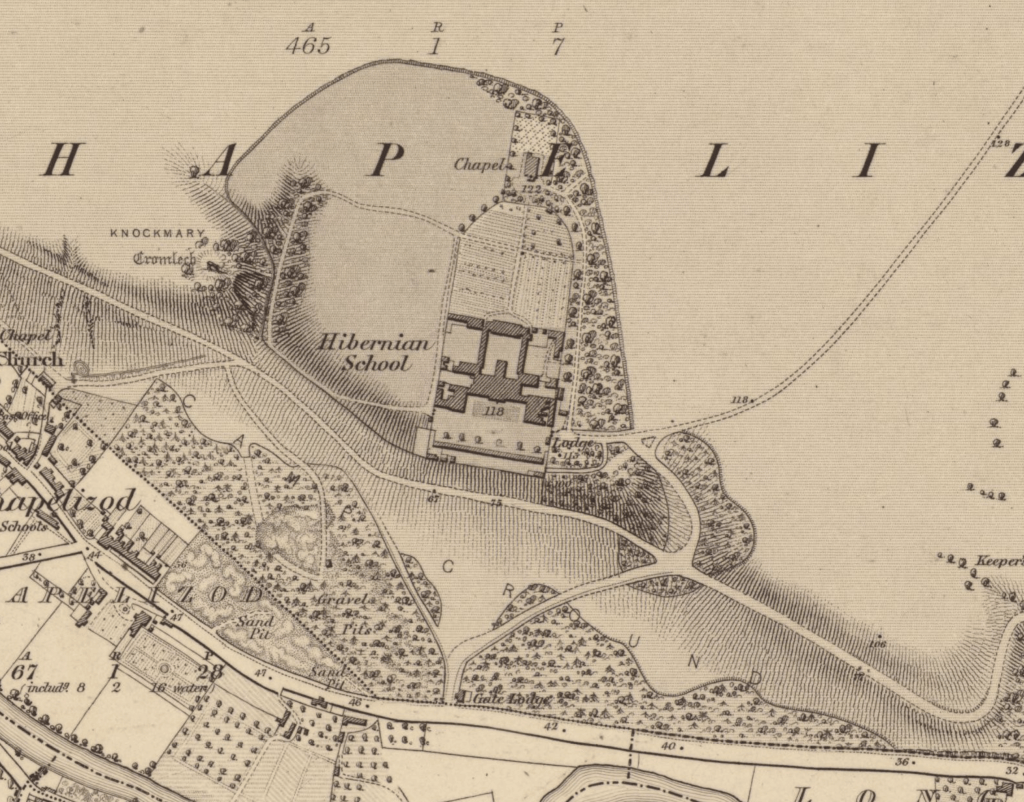
In July 1825, William Young left the Royal Hibernian Military School in Dublin’s Phoenix Park and joined the Army. He was one of ten boys selected from the school for a new kind of military work. They were to become surveyors in an ambitious project to map Ireland.
Young had grown up in an institution founded for the children of soldiers, particularly those whose fathers had died or were serving overseas. By the end of the Napoleonic Wars, around 600 children were being educated there. The boys learned reading, writing and arithmetic, as well as discipline and practical skills. For many, enlistment was the natural next step and an opportunity for improvement and adventure.
He was entering the Army at an unusually fortunate moment. Colonel Thomas Colby was assembling a workforce for the new Trigonometric Survey of Ireland and needed men who could do much more than regular soldiering. Sixty-two of the “most intelligent” soldiers were already being specially trained for the work at Chatham, and draughtsmen were being recruited from the Dublin Society School. [i] Young and the other boys from the Hibernian School were to be taught how to observe, calculate and draw, and how to handle the increasingly sophisticated instruments of the Royal Engineers.
He was remembered as “clever and intelligent” and as a boy who “far outshone his comrades”, with a particular gift for mathematics. By 1830, Captain Henderson trusted the young soldier with calculations for triangulation and trigonometrical heights. Young developed a reputation for extraordinary mental arithmetic and for remembering logarithms and complex calculations that other men needed to look up.
Despite this aptitude, his rank did not keep pace with his ability, but his responsibilities did. While still a soldier in the ranks, he replaced the experienced civilian who had overseen the Survey of Ireland’s computing work. It was an early indication that, within the Survey, technical competence could sometimes matter more than military status.
Eventually, Young moved to Southampton to become one of the Ordnance Survey’s leading mathematical specialists, taking charge of its Computing Branch. The young man recruited from the Hibernian School in Dublin was now helping to solve some of the most demanding mathematical problems in geodesy.
Young’s calculations helped to fix the triangulation across Britain and Ireland. He contributed to George Airy’s 1844 determination of the arc of parallel between Greenwich and Valentia. This was an important test of the Survey’s accuracy, comparing the difference in longitude established by astronomical observations and chronometers with that calculated from the triangulation. The close agreement helped confirm the reliability of the Survey’s measurements.
His work under Captain William Yolland improved the methods for calculating latitude and longitude, making them both more accurate and less laborious. Yolland publicly acknowledged the Survey’s debt to Young’s “quickness, accuracy, and skill at mathematical calculations”. [ii]
Finally, rank followed ability when on 1 April 1853, nearly twenty-eight years after he had enlisted, Young was commissioned as Quartermaster, explicitly “as a reward for his talents and pre-eminently useful services”. He was the first of the Survey’s sappers to receive such a commission.
Even that was not the culmination of his career. He became involved in one of the Survey’s greatest mathematical undertakings: the monumental calculation and adjustment of the Principal Triangulation of Great Britain and Ireland. First, he worked under Yolland, calculating position from zenith-sector observations. Later, he became principal assistant to Alexander Ross Clarke. The calculations were formidable. Thousands of observations taken over nearly seventy years had to be reconciled. Calculations had to account for the curvature of the Earth requiring investigation of its size and shape. Then, they were adjusted to remove local gravitational attraction that deviated the vertical. Finally, the whole network had to be systematically adjusted using the method of least squares. The official history of Ordnance Survey acknowledges that the credit for much of this computational work belonged to Young. [iii]
When William Young left the Hibernian School in 1825, he joined an Army in which birth, education and rank might ordinarily have defined the limits of his career. But the Survey had offered him something different. In the Survey he could apply his mathematical skill and therefore follow a career in which ability could be recognised and responsibility rewarded.
He was not alone. Colby deliberately sought intelligent soldiers, trained them and entrusted them with responsibility in increasingly specialised work. Men who might otherwise have spent their military careers on conventional duties and drills learned to observe, calculate, draw and make decisions for themselves. Some became experts in their own right.
The origins of this approach lay in a military organisation established long before Young was born. In Ireland, it would acquire a distinctive character.
Footnotes
The header image shows a detail from the Ordnance Survey six-inch map, 1837, showing the Royal Hibernian Military School in Phoenix Park. Source: National Library of Scotland. CC BY-NC-ND 4.0
[i] The Dublin Society School was a drawing school founded privately in 1746, then taken over by the Dublin Society, and later evolved into today’s National College of Art and Design. See https://www.ncad.ie/about/history/
[ii] William Yolland, An Account of the Measurement of the Lough Foyle Base in Ireland, with its Verification and Extension by Triangulation (London: Palmer and Clayton, 1847), pp. vii–viii, 149. Yolland identifies Colour-Sergeant William Young, 16th Company Royal Sappers and Miners, as being in charge of the Computing Branch and credits him with improvements to the Survey’s calculations and exceptional mathematical skill.
[iii] W. A. Seymour (ed.), A History of the Ordnance Survey (Folkestone: Dawson, 1980), pp. 136, 143. Seymour records Young as the first Sapper to be commissioned Quartermaster and describes his work under Yolland and subsequently Alexander Ross Clarke.
By subscribing, you will be notified of new posts.
