Drummond and the Problem of Visibility [i]
From the summits of Ireland, when the weather was clear, the surveyors could see beyond the curve of the Earth across extraordinary distances—sixty, eighty, even a hundred miles. In practice, the weather resisted such visibility as the hills were rarely clearly defined. Instead, they lay behind a shifting veil of moisture, mist and cloud, in what was described at the time as “inveterate haze and fogginess.” [ii]
This was not a minor inconvenience but a fundamental obstacle. Each station had to be seen from another, often across vast distances. A pole or beacon on a distant summit might serve at ten or twenty miles, but beyond that, it disappeared into the murk. Without a visible target, the theodolite could not be aligned; without alignment, there could be no measurement; and without measurement, the entire triangulation network was at risk.
The difficulty was not new, as many surveyors had faced similar challenges before. In the late eighteenth century, during the Anglo-French triangulation, General William Roy had experimented with artificial lights. Bengal lights and other military pyrotechnics were used to create bright but short-lived targets. These were supplemented by Argand lamps mounted in front of parabolic reflectors, much like those used in lighthouses. By the early nineteenth century, French engineers such as Fresnel and Arago had developed a new lens system capable of concentrating light into a powerful beam, extending the range at which it could be seen. These innovations would transform lighthouse design, but their application to triangulation remained limited.
In daylight, another approach emerged. Carl Friedrich Gauss, the German mathematician and geodesist, devised a method for reflecting sunlight using mirrors. By directing a controlled beam of sunlight towards a distant observer, it was possible to create a bright, precise point of reference that shone across considerable distances. This would later be known as the heliotrope. [iii]
These methods worked to a point but were inconsistent, labour-intensive, and often insufficient for the long lines required in Ireland, where the atmosphere dulled their brightness. The Gauss device required constant adjustment to follow the sun, and it depended on clear skies.
Colonel Thomas Colby, preparing for the Irish survey, recognised the scale of the challenge. He needed something more reliable to extend visibility beyond existing techniques. For this, he turned to a young Royal Engineer whose combination of scientific curiosity and practical skill marked him out as exceptional.
Thomas Drummond was not yet thirty. Born in Scotland in 1797, he showed early promise in mathematics and science, along with a restlessness and ambition that led him to be commissioned into the Royal Engineers at a young age. [iv] He soon came to the attention of Colby, who recognised in him both intellectual ability and an unusual “energy of character.” By the early 1820s, Drummond had gained experience working on the triangulation in Orkney and Shetland, under demanding conditions. [v]
By 1823, Drummond was in London, where his most significant work began. Colby directed Drummond to “consider what means our distant stations might be rendered more frequently observable than the state of the atmosphere usually permits”. [vi] Immersed in lectures, demonstrations, and scientific exchange, he was tasked by Colby with solving the problem of illumination. He began by studying existing methods and improving them. He refined the use of mirrors to reflect sunlight over long distances and, through a series of experiments using tin plates as reflecting surfaces, demonstrated that signals from Leith Hill in Surrey and Wrotham Hill in Kent could be seen from Berkhamsted, some forty-five miles away, even through the haze that often lay over the Thames Valley.
Crucially, he also simplified the operation. He devised an apparatus that could maintain the reflected sun’s alignment in a constant direction as the sun moved across the sky. Just as importantly, it could be operated by a non-commissioned officer, rather than requiring constant adjustment by a skilled observer. [vii] This was no small advance in a field where reliability and ease of use mattered as much as theoretical performance.
But sunlight could not be relied upon, and Ireland’s weather, as the surveyors already knew, did not guarantee clear skies. A solution was needed that would work at night or in cloudy conditions, independent of the sun’s rays.
A breakthrough came from an unexpected source. At the Royal Institution, Drummond attended a demonstration by Michael Faraday, who was investigating the properties of intense light produced by heating certain materials to incandescence. Among these, lime or calcium oxide proved particularly striking. When heated in a flame fed by oxygen and hydrogen, it emitted a brilliant white light of extraordinary intensity.
Drummond immediately saw its potential and began a series of experiments, testing different substances and configurations. The results were decisive. Lime, when properly heated, produced a light far brighter than the Argand lamps, estimated as more than thirty times as intense. More importantly, it produced a steady, concentrated point of light that could serve as a precise target for observation in the theodolite.
When demonstrated publicly before an audience of scientists and engineers at the Tower of London, the effect was dramatic – those who saw it gave a spontaneous “shout of triumph and admiration”. The new light was described by Sir John Herschel as a “magnificent spectacle”; the beam’s intensity overwhelmed all other sources of light in the room.
For Drummond and Colby, the implications were practical. Here, at last, was a light that could be seen across great distances, one that could pierce the haze in the day, function at night, and provide a stable point target for theodolite observation. It transformed the problem of visibility. By day, reflected sunlight, carefully directed, could create a bright, focused point. Without sunlight or at night, Drummond’s limelight could serve as a fixed, brilliant target. Together, they extended the reach of triangulation beyond what had previously been possible.
The real test came on the mountains of Ireland, where theory would meet weather, terrain and distance. The apparatus would have to be transported, assembled, protected from the elements, and operated under conditions far removed from the controlled environment of a lecture hall or laboratory. Early work began when Colby and a party of surveyors climbed Divis Mountain near Belfast to start the observations. Divis had been chosen for its strategic position in the emerging network. [viii] From there, attempts were made to observe survey stations on distant mountains, including Slieve Snaght in Donegal, some sixty-seven miles away.
The distances lay at the very edge of what had previously been achieved. For weeks, success remained elusive. The atmosphere refused to cooperate, and the signals failed to appear. The surveyors had no choice but to wait, to watch, and to try again.
Winter approached, and with it came worsening weather and mounting pressure from London for progress in these early, critical days of the survey. Yet winter, between the storms, low cloud, rain, and snow, also brought moments of exceptional clarity, with still air and skies free of haze. The season forced a decision—should they abandon further attempts until the following year?
What followed became one of the most vivid episodes in the history of the survey in Ireland: an observer waiting for a pinprick of light to appear sixty-seven miles away, despite the cold, the weather, and the distance.
Sources and References
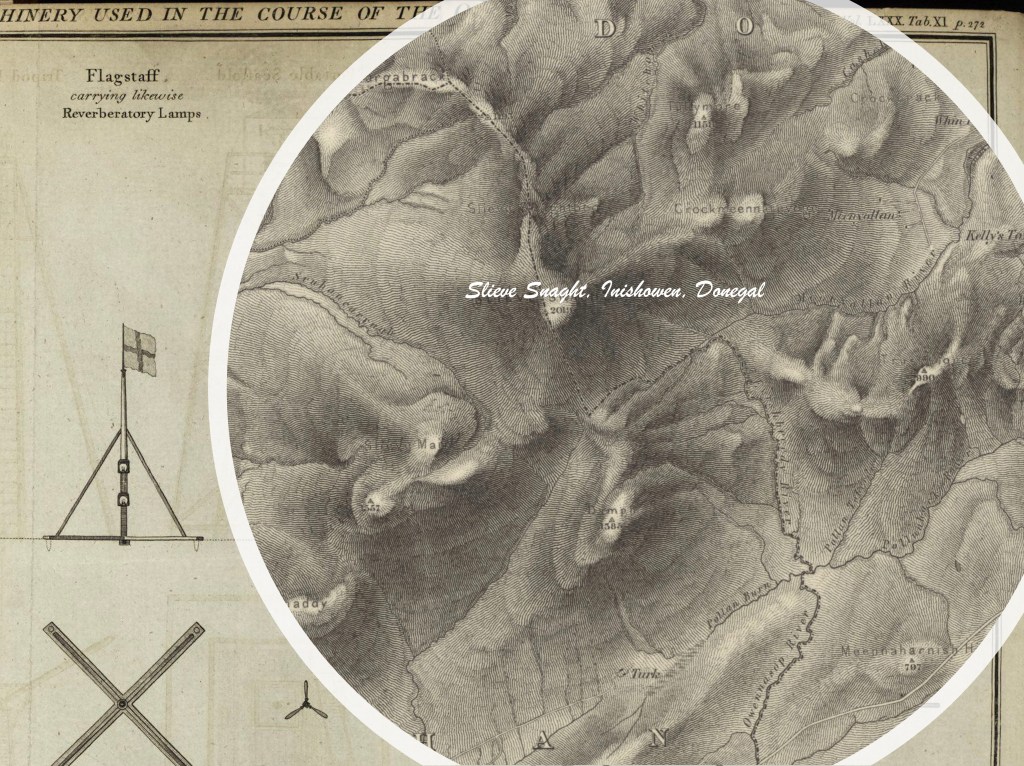
The map used in the header image of Slieve Snaght is reproduced with the permission of the National Library of Scotland, CC-BY (NLS) https://maps.nls.uk/
[i] Sources for this article include: “On the means of facilitating the observation of distant stations in geodetical operations” by Lieutenant T Drummond, April 14, 1826, and “On the Illumination of Light-houses.” By Lieut. Thomas Drummond, of the Royal Engineers. Communicated by Lieut. Colonel Colby of the Royal Engineers, F.R.S. Read June 17th, 1830. Downloaded from The Royal Society Philosophical Transactions, 27.01.2023.
[ii] Colby’s first report to Sir Henry Hardinge KCB, January 1826; NAI, OS/1/1.
[iii] Also termed a heliostat by many surveyors, although a heliostat is a signalling lamp, whereas a heliotrope is a surveyor’s target light. Heliostats can, and have been used as a survey target.
[iv] Just short of his 18th birthday: Letter to his Aunt 26th March 1813, “Thomas Drummond Life and Letters” by R. Barry O’Brien. London 1889, p12.
[v] “Account of the Observations and Calculations of the Principal Triangulation”, Eyre and Spottiswoode, 1858; p v and Section IV.
[vi] “On the means of facilitating the observation of distant stations in geodetical operations” By Lieutenant T Drummond, April 14, 1826”, downloaded from The Royal Society Philosophical Transactions, 27.01.2023.
[vii] Colby’s first report to Sir Henry Hardinge KCB, January 1826; NAI, OS/1/1.
[viii] Work began on 24th of July 1825: Lt. Col. Colby, first “Report to Sir Henry Hardinge KCB on the Present State and Progress of the Irish Survey” NAI, OS/1/1.
By subscribing, you will be notified of new posts.

Responses
[…] → Read Post 19 […]
LikeLike
[…] story is told in the next stage of the journey, in the post Inveterate Haze and Fogginess: Drummond and the Problem of Visibility, to be published next […]
LikeLike