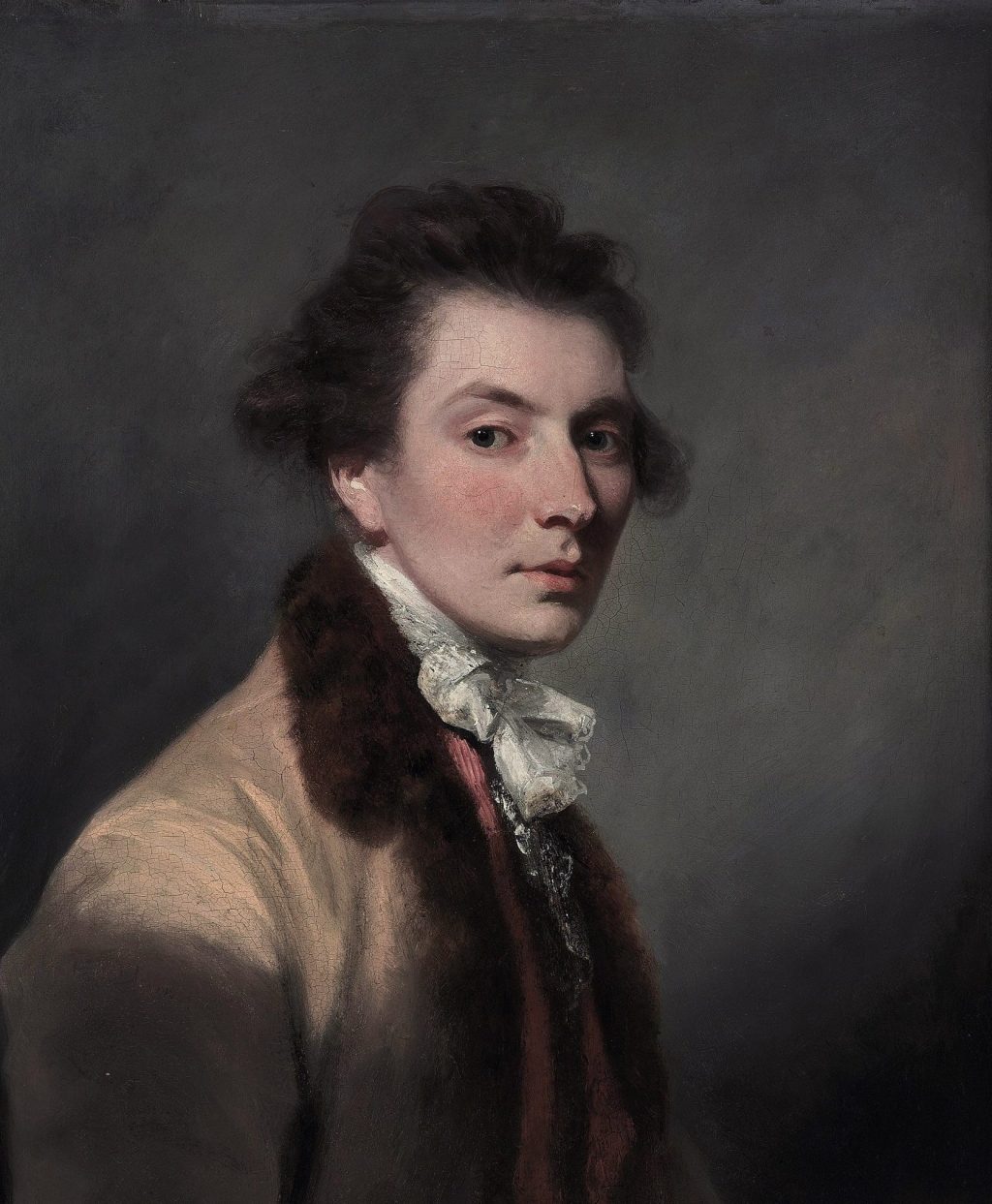
Luke Gardiner, 1st Viscount Mountjoy (1745-1798),
painted by Sir Joshua Reynolds.
Source Wikipedia
“A young man from our ranks
A cannon he let go
And slapped it into Lord Mountjoy
A tyrant he laid low”
“The Boys of Wexford”, Robert Joyce and Arthur Darley.
Nearly two hundred years before my arrival, the United Irishmen, frustrated by the lack of political reform in Ireland and inspired by the American and French revolutions, rebelled against British rule in Ireland. Just before dawn on the 5th of June 1798, ten thousand rebels attacked two thousand five hundred government troops garrisoned in New Ross, County Wexford. Luke Gardiner, the 1st Viscount Mountjoy, died leading the Catholic Dublin Militia against the rebels. The rebellion, which would cost the lives of tens of thousands of people,[1] was suppressed, and before long, Ireland and Britain became a United Kingdom. It was the ghost of Mountjoy that is said to haunt the grounds of Mountjoy Barracks.
Mountjoy House, the headquarters of the Ordnance Survey in Ireland, was already nearly one hundred years old by the time the Survey arrived in 1824. It had been built in 1728 by the grandfather of Viscount Mountjoy, also called Luke Gardiner, one of two Keepers of the Park. Originally called Castleknock Lodge, it had become known as Mountjoy House over time. The first Luke Gardiner had been a property developer in Dublin and is famous for laying out Gardiner’s Mall, which was later renamed Sackville Street and then became O’Connell Street. He bequeathed his Estate to his son, Charles, who, in turn, left it to his son, Luke.
This second Luke Gardiner was raised to the Irish peerage as 1st Viscount Mountjoy, a title revived through the family of his grandmother, Anne Stewart. He built a small theatre at the rear of the house, where Macbeth was said to have been performed, a play in which even “stones have been known to move, and trees to speak”, a line uncannily apt for a house that bears witness to history, its walls, grounds, and memory conspiring to reveal what the past would prefer to forget. The decorative plasterwork of the theatre survived long enough to be admired within the old administrative offices as late as 1994. Despite Mountjoy’s violent end, and his later characterisation as a tyrant, he was remembered as a man of notably gentle disposition, described as having “the mildest affections… so benevolent and humane that he never harboured revenge.”
Private residences and interests gradually disappeared from the Phoenix Park once the Viceregal Lodge (now Áras an Uachtaráin) was bought by the government in 1782. Following Mountjoy’s death in 1798, the government bought the house for the Secretary of War. By 1812, barracks and a parade ground had been built to house the cavalry escort for the Lord Lieutenant of Ireland, resident at the Viceregal Lodge, and the whole site had become known as Mountjoy Barracks. As a military building, it came under the control of the Board of Ordnance, then, in 1825, this “admirable house” [2] was handed over for the use of the recently established Trigonometrical Survey of Ireland.
__________________
[1] “The Gardiner Family”, S J Murphy, Studies Irish Genealogy and Heraldry 2010, p28-35.
[2] The Early Years of the Ordnance Survey”, Colonel Sir Charles Close, Institution of Royal Engineers, 1926.
By subscribing, you will be notified of new posts.
